
Q-CueGraph: Query-Conditioned Visual Evidence Graphs
Q-CueGraph asks which visual evidence a multimodal model should actually inspect for a given query. Instead of requiring a frozen multimodal large language model to discover relevant evidence implicitly from an entire high-resolution image, it constructs task-conditioned evidence proposals and turns them into explicit coordinate-level observations.
Authors: Pengcheng Pan and Xinfang Zhang
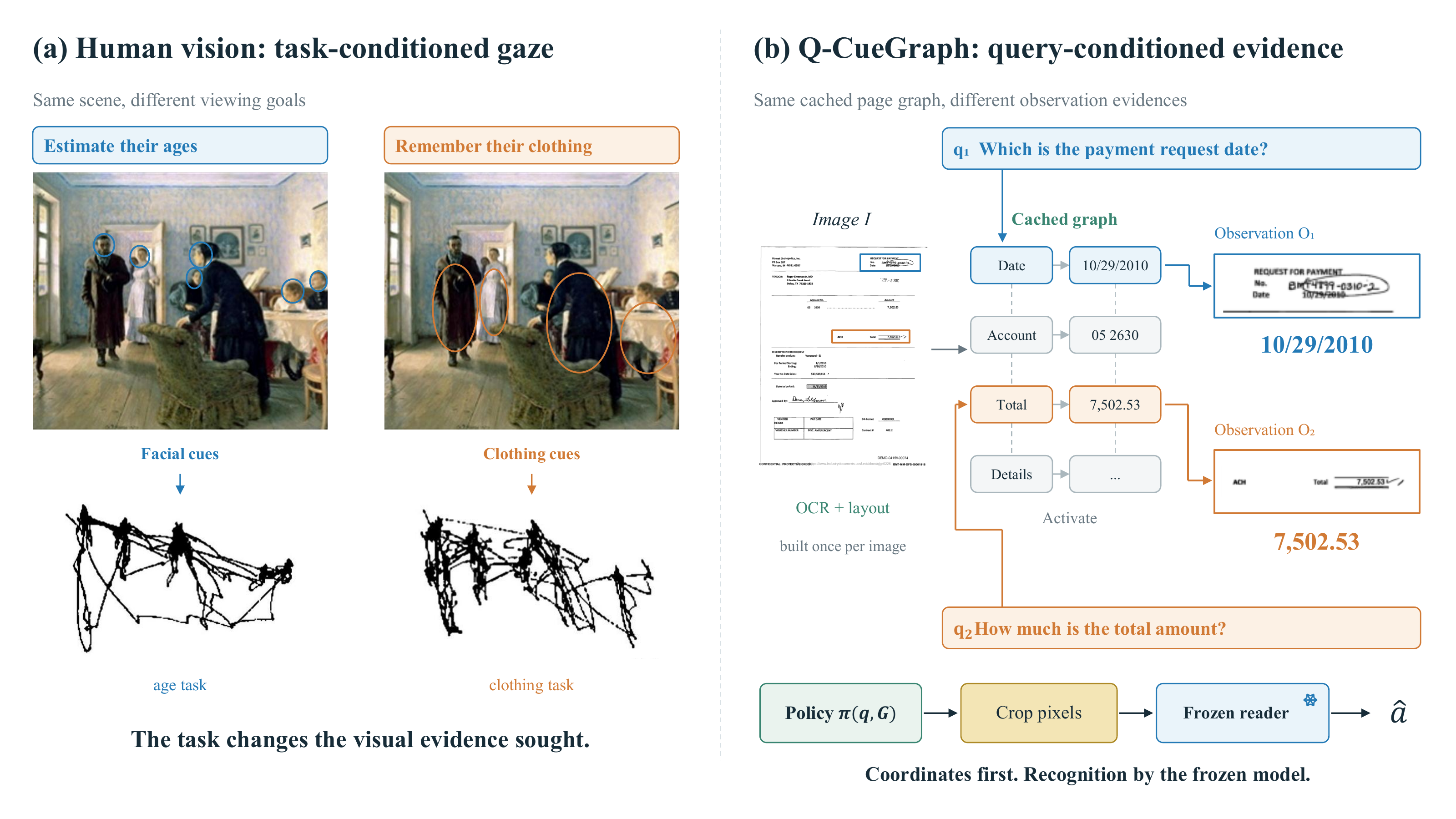
Task-conditioned observation links human goal-directed gaze with explicit visual evidence selection for multimodal reasoning.
Key idea
Query → evidence selection → explicit observation → frozen multimodal reasoning
For text-rich images, Q-CueGraph builds a reusable OCR/layout graph once per image, activates it for each query, expands through structural relationships, and ranks and composes selected regions into an explicit crop for a frozen reader.
For natural images, query-conditioned visual nodes use the same selection, composition, and budgeting interface. The reported experiments use a frozen Qwen2.5-VL-7B reader.
Selected public results
- V*Bench: accuracy improves from
0.696with full-image inference to0.833while observing approximately19%of the image area. - InfographicVQA: approximately
92%of full-image ANLS using about half of the image area.
Paper: arXiv:2608.04452
Keywords: multimodal reasoning, visual evidence acquisition, vision-language models, OCR/layout graphs, query-conditioned observation.